What Nobody Tells You About Making the Shift
There is a story we hear often in creative circles. A woman starts making things (cards, paintings, patterns, jewellery) and before she quite realises what has happened, people are asking to buy them. Orders trickle in. Word spreads. A business is born, almost by accident, almost effortlessly, as if the universe simply conspired in her favour.
It’s a beautiful story. And for a rare few, it may even be true.
But for most of us, the shift from hobby creativity to professional creativity is not a gentle drift. It is a decision, a deliberate, sometimes uncomfortable, often humbling decision, and it requires a fundamentally different way of thinking about your creative work.
If you’ve ever tried to earn income from your art, given it a few attempts, felt the quiet sting of disappointment, and wondered whether you simply aren’t cut out for it – this article is for you. Because the problem is rarely the art. The problem is that nobody told you the rules of the game had changed the moment you decided to play professionally.
What Hobby Creativity Actually Looks Like
Let’s start by naming what you’re leaving behind, because it deserves to be honoured before we ask you to shift out of it.
Hobby creativity is a gift. You follow inspiration wherever it leads. You buy the watercolours because they’re beautiful, the linen because it called to you, the new sketchbook because a fresh page feels like possibility. You work when the mood strikes. You create what you want, in the style you feel like, at the pace that suits you. The only deadline is your friend’s birthday, and even then, you give yourself grace.
There is no wrong answer in hobby creativity. You can try botanical illustration one month and abstract acrylics the next. You can pivot, experiment, abandon a project halfway through, and start something entirely new with no consequences beyond a slightly overstocked art cupboard.
This freedom is not a flaw. It is part of how God designed the creative impulse: generous, exploratory, delight-driven. “He has made everything beautiful in its time” (Ecclesiastes 3:11). Hobby creativity is you participating in that beauty, for its own sake, for the joy of it.
But the moment you decide you want that creativity to generate income, to serve clients, to build something lasting, the rules change. And if you don’t know that, you will keep playing the hobby game in a professional arena, and wonder why it isn’t working.
The Moment the Shift Has to Happen
Professional creativity is not what happens when your hobby gets popular enough. It is what happens when you make a decision.
That decision sounds something like this: I am going to treat my creative work as a business. That means I will think strategically, act consistently, and build systems that allow this to sustain itself over time.
It sounds simple. It is not easy.
What I see most often among creative women is this: they try something. They open an Etsy shop, post a few things on Instagram, offer a commission or two, and when the response is lukewarm, they conclude one of two things. Either the market doesn’t want what they make, or they’re simply not business-minded enough to make it work. Then they move on. A new medium, a new platform, a new idea. The cycle repeats.
But one or two attempts at earning income from your art is not a business. It is a test run that ended before the experiment had time to produce real data. Professional creativity requires sustained, strategic effort over a meaningful period of time. And most of us abandon the process long before we reach the point where it could actually work.
The shift isn’t just practical. It is also a matter of stewardship. If God has given you this creative gift (and He has!) then building something sustainable with it is an act of faithfulness, not ambition. “Whatever you do, work at it with all your heart, as working for the Lord” (Colossians 3:23). That includes the unglamorous parts: the admin, the planning, the pivoting, the starting again.
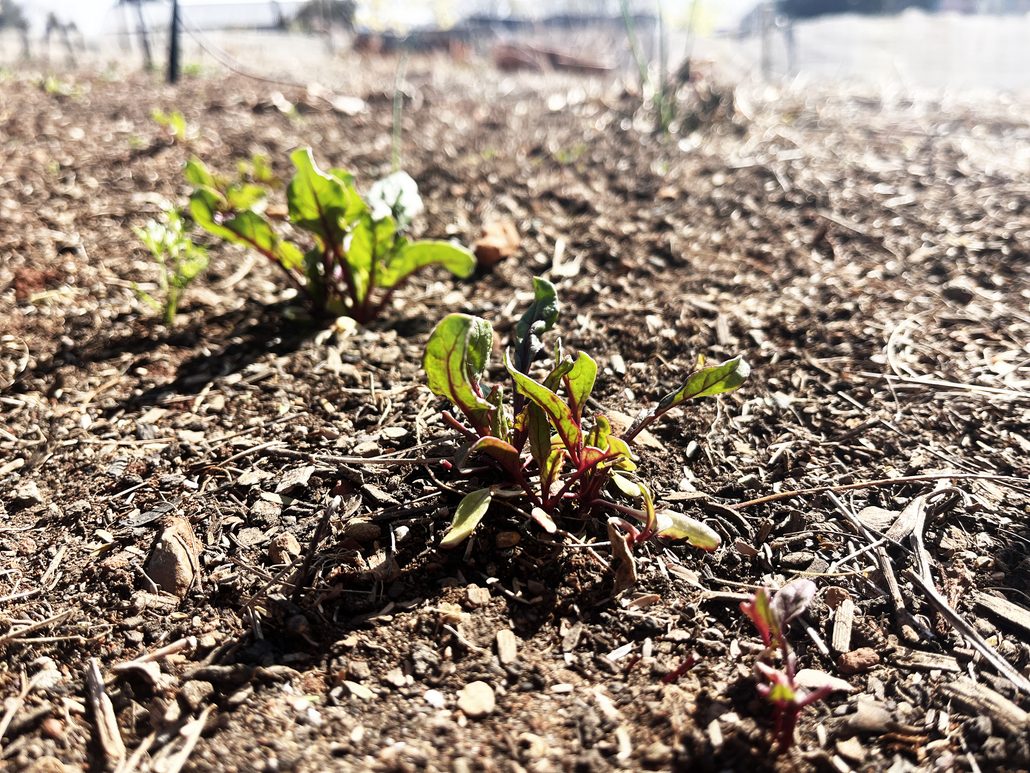
The Garden: What Happens When You Scale Without a System
I want to tell you a story from my own life, because I think you’ll recognise yourself in it.
When we lived on a farmstead, I fell in love with growing things. I started with a modest row of vegetables – neat, manageable, full of promise. Then I added more beds. A wider variety. Companion plants to attract beneficial insects. Before long, I had convinced my husband that we needed to double the size with a different layout entirely, because I wanted to grow enough to sell the overflow.
It made perfect sense in my head. More growing space meant more produce meant more abundance meant income. What I hadn’t planned for was how to harvest at scale, how to package the produce, who exactly I was selling to, and how it would get from our garden to their table.
The garden kept growing. My four daughters and I were out there almost daily. And the abundance (which should have felt like a victory) slowly became a source of exhaustion. We had invested so much. We loved the lifestyle. But without systems, the very thing I had built to bless us was beginning to drain us.
This is exactly what happens to creative women who dive into professional creativity without a plan.
More mediums. More platforms. More client types. More products. More ideas running simultaneously. The creative equivalent of doubling the garden before you’ve figured out the harvest. It feels like momentum. It feels like growth. Until the weight of it all becomes more than you can carry, and you find yourself overwhelmed by the very thing you built because you loved it.
The solution isn’t to want less. It’s to build better.
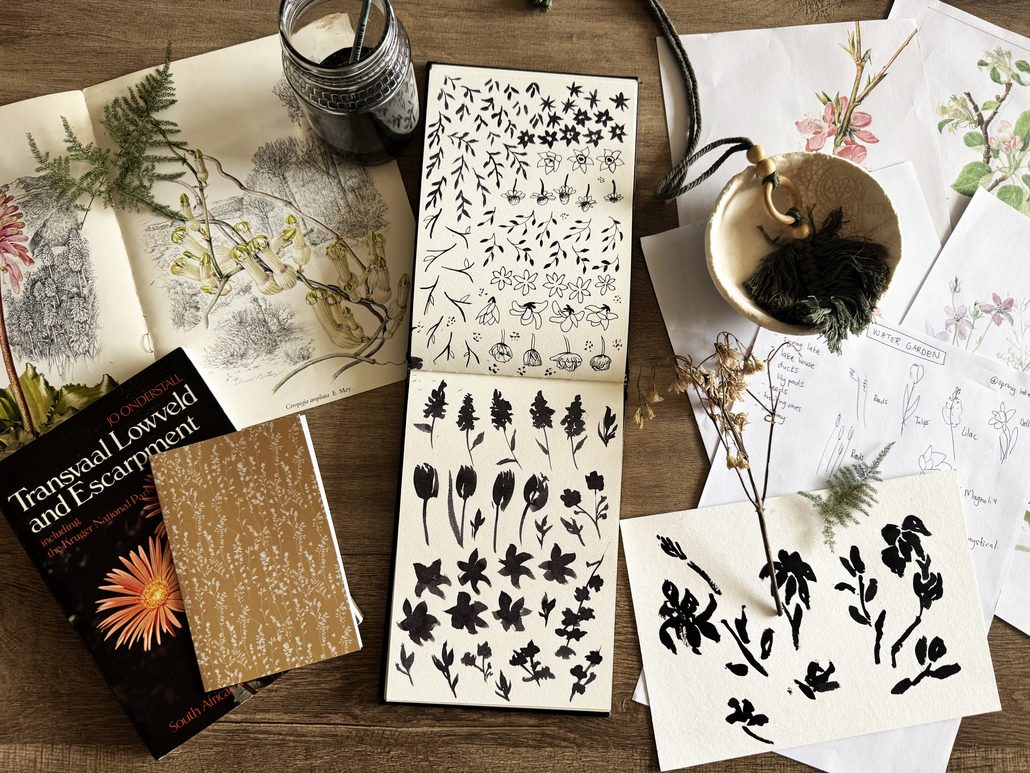
The Golden Thread
When I finally decided to narrow my focus, I was afraid.
Afraid I would choose the wrong thing and grow tired of it. Afraid I would miss out on the other things I loved. Afraid that narrowing down meant shrinking (that it was a kind of creative poverty rather than creative wisdom).
What I discovered was the opposite.
The things I eventually settled on (hand-drawn botanical illustration, surface pattern design, the natural world as my subject matter) had been present throughout my creative life. Not always named. Not always primary. But always there, running like a golden thread through everything I had made and loved and returned to.
I hadn’t noticed the thread until I slowed down enough to look for it. Until I asked God to show me where He was leading rather than trying to manufacture a direction on my own. Until I got brave enough to set some boundaries and see what remained when the noise cleared.
What remained was exactly what I was meant to build with.
Narrowing your focus is not the end of your creative freedom. It is the beginning of your creative clarity. And clarity, for a professional creative, is one of the most valuable things you can possess.
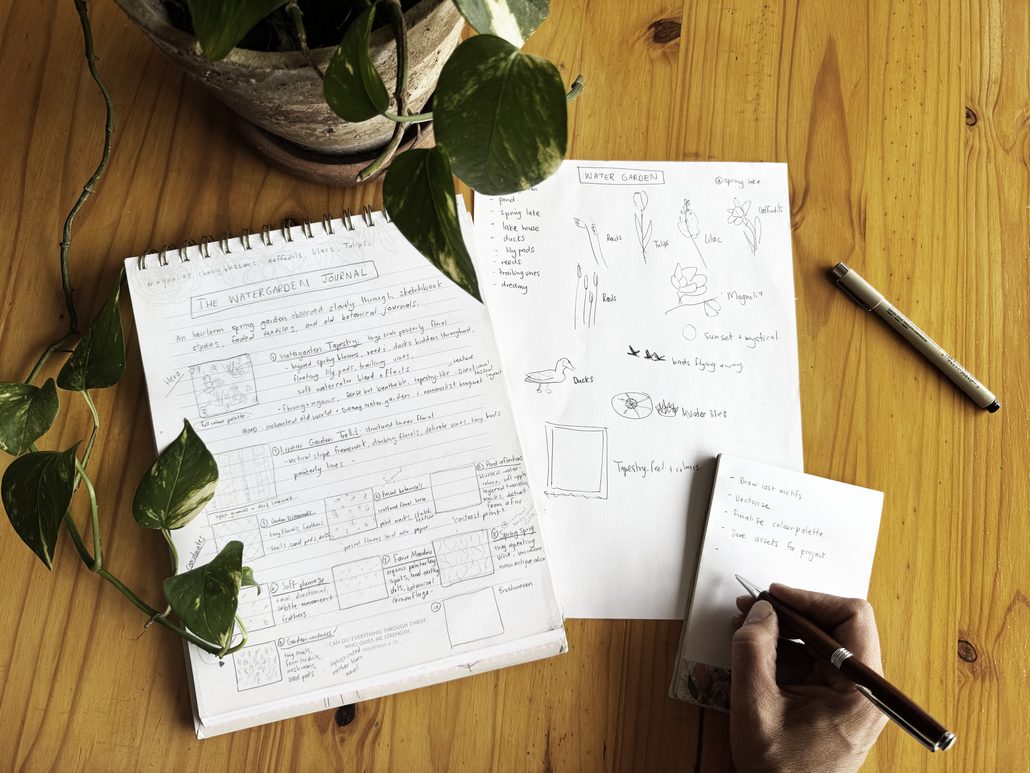
What Professional Creativity Actually Requires
Once the decision is made and the focus is found, the real work begins – and it looks different from what most people expect.
Professional creativity is not primarily about making more art. It is about making the right art, for the right people, through the right channels, in the right season.
This means asking (and honestly answering) a handful of clarifying questions before you invest time or energy in any activity:
What is my goal for this season? Growing your portfolio looks different from landing your first licensing client. Building your newsletter looks different from launching a course. Every season has a primary goal, and your activities should serve that goal, not distract from it.
Who is my ideal client, and where are they actually spending time? If your goal is licensing your surface pattern designs to manufacturers, and the people engaging with your Instagram are mostly fellow artists, then hours spent on Instagram each week are not moving your needle. They may be enjoyable. They may even feel productive. But they are not strategic.
What are the fewest activities that will move me toward my goal? A sustainable creative business is not built by doing everything. It is built by doing the right things consistently, over time. Phone outreach to companies. A well-curated portfolio. A targeted email pitch. A relationship carefully built on LinkedIn over months. These unglamorous, focused efforts often outperform a polished social media presence ten times over.
The question to keep returning to is simple: Is what I’m doing right now actually moving me toward where I want to go?
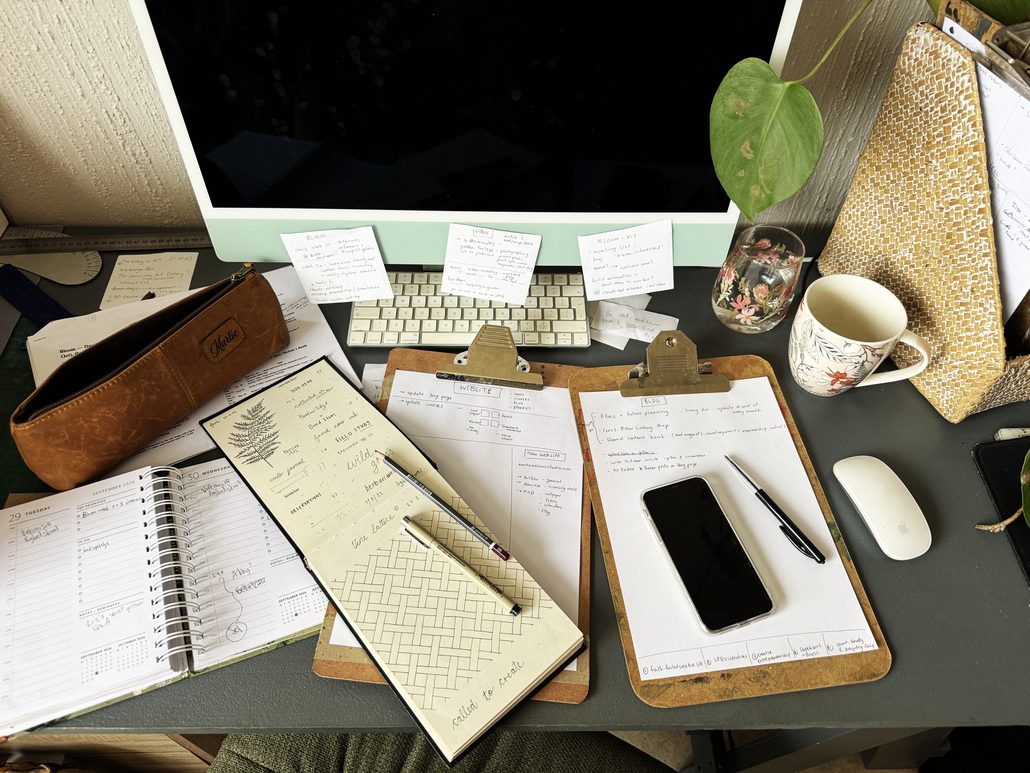
The Noise Problem
Here is what the internet will tell you a creative business requires: a beautiful Instagram feed. A consistent Pinterest strategy. A weekly newsletter. A blog. A podcast. A YouTube channel. A website that converts. An email sequence. Live events. Digital products. A community. A course.
And perhaps, eventually, some of those things will be part of what you build.
But not all of them. Not at once. Not before you’ve built the foundation.
The noise of modern creative business is genuinely loud, and it is designed to make you feel perpetually behind, perpetually inadequate, perpetually in need of one more strategy, one more platform, one more tool. The result for most creative women is a frantic kind of busyness that feels like progress but produces very little of lasting value.
A sustainable creative business is quieter than the internet suggests. It is built on clarity about what you offer and who you serve. It runs on systems simple enough that you can maintain them through a full season of life (through the school holidays, the difficult months, the creative dry spells). It grows slowly and steadily, rooted deeply enough to weather the seasons that don’t feel fruitful.
That kind of business does not happen by accident. It happens by decision, and then by the daily, faithful, unglamorous work of building it one right action at a time.
The Business That Brings Peace
The creative business worth building is not the loudest one, or the largest one, or the one that impresses other creatives most on Instagram.
It is the one that fits your life. The one that honours the specific creativity God placed in you. The one that grows at a pace you can sustain without burning out or abandoning the work you love. The one that, five or ten years from now, is still standing (still creating, still serving, still generating income) because it was built on something real.
That business begins with a decision. Not with inspiration, not with a viral moment, not with the perfect product or the perfect platform or the perfect season of life. With a decision to take your creative calling seriously, to steward it well, to build strategically, and to trust that slow, faithful growth is not a consolation prize. It is the plan.
You don’t have to do everything at once. You don’t have to have it all figured out before you begin. But you do have to decide that this is real. That your creativity matters enough to treat it with intention.
When you make that decision, everything else becomes clearer.
If you’re in the early stages of making this shift, from hobby to professional, from experimenting to building, the Abundance Newsletter is where I share honest, practical, faith-rooted guidance for the creative journey. And if you’re ready for a community of women doing this work alongside you, the Rooted Creative Circle is where we grow together. I’d love to have you in both.
Hi Martie
This is very interesting and eye-opening because it makes such good sense! Thank you for sharing this wisdom from experience.