
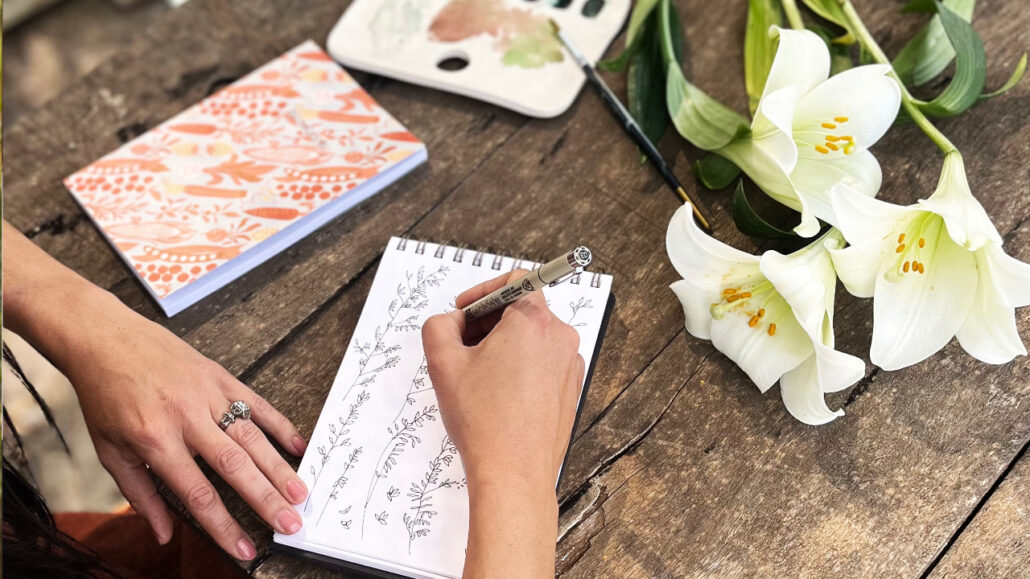
I still remember the first time I truly noticed a collection.
I was standing in a beautiful art shop, slowly flipping through botanical notebooks displayed across a wooden table. One notebook caught my eye immediately. The cover artwork felt thoughtful and layered, but what fascinated me even more was opening it and discovering that the inside cover carried the same feeling without repeating the exact same design.
Then I picked up another notebook in the range.
And another.
Suddenly I began noticing the thread connecting them all together.
The colours spoke the same language. The motifs felt related. The atmosphere remained consistent, even though each design was entirely different. As my eyes scanned the rest of the display, I saw pens, diaries, smaller notebooks, and shopping list pads all working together within this same botanical story.
And something inside me leapt.
At the time, I didn’t yet understand how intentional the backbone of a collection really was. I only knew that this type of cohesive beauty made me want to linger longer. It invited me to observe more carefully, to feel something deeper, and to step into the world the artist had created.
That is the power of collection building.
A collection allows us to take a deep dive into a story or theme rather than offering only a single glimpse. It invites the viewer to stay awhile. To explore. To connect. To notice relationships between pieces and discover meaning woven throughout the work.
And perhaps that is why collections feel so special in a culture that moves so quickly.
We are surrounded by endless scrolling, fleeting trends, and disposable content. Yet a thoughtfully crafted collection slows us down. It creates a sense of rhythm, atmosphere, and continuity.
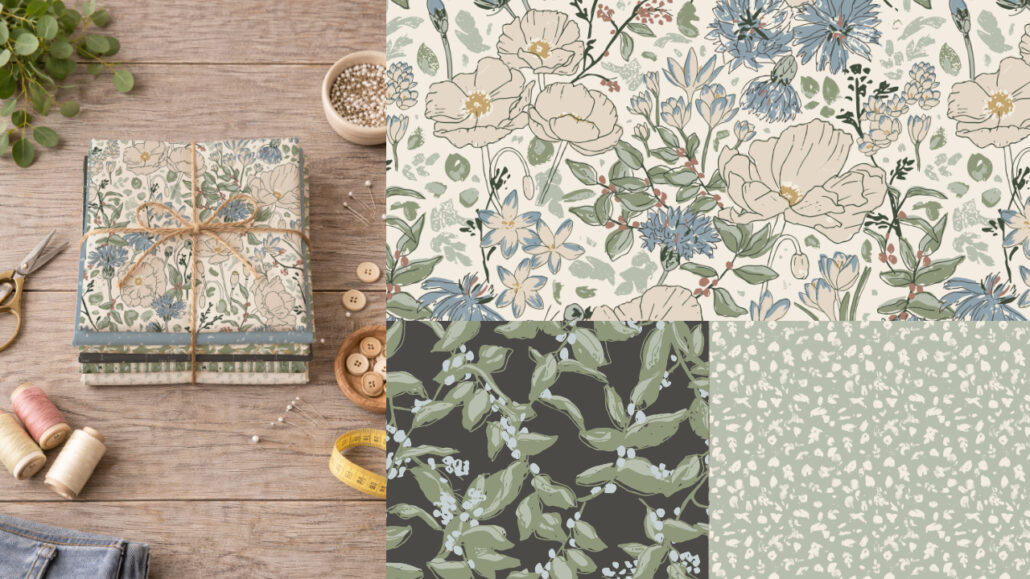
If you have ever held a beautifully pieced quilt in your hands, you understand this instinctively. Every fabric contributes to the larger story. Every colour, scale, and motif plays its role. The right combination of patterns creates harmony, movement, depth, and emotional resonance.
Collections are not simply a group of random patterns placed beside one another.
They are stories told visually.
And the strongest collections are built with intention.
Why Collections Matter
One of the most beautiful things about collection building is that the end use shapes the way the story unfolds.
A wallpaper collection, for example, functions very differently from a quilting fabric collection.
If I am designing wallpapers, I know the end user will most likely select one main pattern for a feature wall while perhaps incorporating supporting prints through curtains, cushions, or smaller decorative elements. In this case, the collection provides options for storytelling within a space.
But quilting fabric works differently.
A quilt combines many patterns into one final art piece, which means the collection needs stronger consideration for tonal value, contrast, scale, rhythm, and visual breathing room. Each print must support the whole while still contributing something unique.
Stationery collections function differently again. Hero patterns may dominate notebook covers while supporting coordinates and blenders quietly strengthen the range through interior pages, pens, packaging, or secondary products.
The more I studied collections, the more I realised something important:
A cohesive collection is never accidental.
It is thoughtfully guided.
And personally, my analytical brain absolutely loves this part of the process.
I enjoy plotting out the structure beforehand:
• scale variations
• colour balance
• tonal contrast
• hero placement
• coordinating prints
• supporting blenders
• rhythm and movement
A good plan goes a long way in saving time and creating clear direction.
But what I love even more is the moment later in the process when the collection suddenly begins to “click.”
There is always a point where each new pattern starts filling a specific gap and the entire body of work begins to feel connected — almost like a choir singing in harmony.
That moment never gets old.
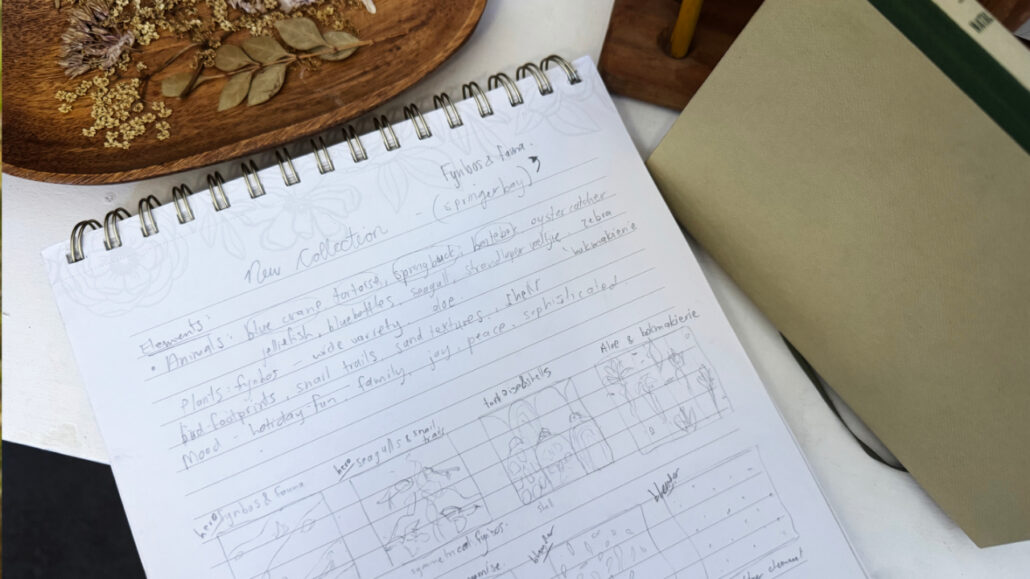
Story Is the Backbone of a Collection
If there is one thing I have learned through building collections, it is this:
Story forms the foundation of cohesive work.
It guides:
• motif choices
• colour palettes
• texture
• rhythm
• layout
• mood
• and emotional atmosphere
Everything becomes connected through the story.
Some stories are deeply personal and reflective.
Others are playful, nostalgic, whimsical, or trend-inspired.
But the collections that tend to linger in people’s hearts are often the ones carrying an additional layer of meaning beneath the surface.
People long for story.
Especially in a world that can sometimes feel rushed, cold, and impersonal.
And stories create emotional connection.
I think this is also why humans are naturally drawn toward cohesive beauty.
When we walk into a beautifully curated interior store, we immediately sense when everything belongs together. The colours, materials, textures, lighting, and styling all work together to create atmosphere and emotional resonance.
Nature itself reflects this beautifully.
When sunlight falls across a garden bed, the entire atmosphere shifts together in harmony. The colours soften. Shadows deepen. Textures become richer.
Compare the lush atmosphere of the Amazon rainforest to the bright energy of a summer day on Miami Beach. Both are beautiful. Both tell entirely different stories through colour, rhythm, texture, scale, and movement.
Nature constantly reminds us that cohesion creates emotional impact.
And as artists and designers, we are invited to thoughtfully build that same sense of harmony into our work.
Why So Many Creatives Struggle With Cohesion
One of the biggest reasons creatives struggle to build cohesive collections is because they are afraid of boundaries.
They hesitate to:
• limit their colour palette
• narrow their theme
• define a target market
• simplify their motifs
• or work within a specific end use
They fear limitations will restrict creativity.
But interestingly, I have found the opposite to be true.
My creativity flourishes within boundaries.
In fact, if there are not enough boundaries, I often create some intentionally because limitations help me make clearer decisions and focus more deeply on the story I actually want to tell.
Too many options can create noise.
Focused limitations create clarity.
This was especially true in my own relationship with colour.
For a long time, I struggled to create cohesive palettes because my emotions constantly pulled me in different directions. One day I wanted bright, joyful colour combinations. The next day I wanted bold contrast and experimental palettes.
And although some of the individual pieces were beautiful, the work often felt disconnected from me.
It lacked consistency.
But over time — through creating both good art and really bad art — I slowly began discovering which colours, motifs, textures, and emotional atmospheres genuinely felt aligned with my voice as an artist.
It became a process of self-discovery with God.
Learning:
• how He made me different
• what stories naturally draw me in
• what emotional atmosphere feels authentic
• and what I truly want to send out into the world
The more I create, the clearer this becomes.
And I suspect this process never fully ends.
Our work continues evolving as we grow, move through different seasons, and remain inspired by life and God’s creation around us.

Permission to Edit Ruthlessly
One of the most important skills in collection building is learning to edit.
And honestly, this can be difficult.
I have created beautiful individual motifs before that simply refused to work together cohesively. Recently, I worked on a children’s quilting collection that looked promising at first, but once I placed everything into a quilt mockup, the collection felt chaotic and disconnected.
There were simply too many competing ideas happening at once.
So I made a difficult decision.
I cut the collection in half.
And suddenly it worked.
The remaining patterns finally told a stronger, more cohesive story together.
That experience reminded me that not everything we create needs to stay in the final collection.
Sometimes we hold onto patterns because we invested time into them and desperately want that effort to feel worthwhile. But when we cling too tightly to elements that are not serving the larger vision, the entire collection suffers.
I actually keep a folder on my computer called:
“Not Gonna Use.”
Whenever something does not fit, I simply drag it there.
Not as failure.
Just not for this collection.
Sometimes those motifs return later in an entirely different body of work where they finally belong.
Editing is not rejection.
It is refinement.
Understanding the Building Blocks of a Collection
As collections grow, different types of patterns begin serving different purposes within the range.
Hero Prints
Hero prints are the main characters of the story.
They carry the strongest emotional impact and usually contain:
• the richest detail
• the most visual interest
• layered motifs
• texture
• stronger storytelling elements
• and often larger scale
Hero prints are often the patterns that appear on:
• notebook covers
• statement fabrics
• wallpaper features
• or art prints
Larger collections may contain two or three heroes while smaller collections may only need one.
Secondary Prints
Secondary prints support the hero.
Think of them as the best friend in the story.
They remain visually interesting but carry slightly less complexity, detail, or dominance than the hero print.
Contrasting scale, movement, or colour can help create balance between hero and secondary prints.
Coordinates
Coordinate prints fill much of the collection and help strengthen variety across the range.
They support the story while creating movement, balance, and flexibility.
These prints often contain:
• simpler motifs
• less detail
• softer rhythm
• or more limited colour usage
Blender Prints
Blenders provide visual breathing room.
These are often:
• dots
• stripes
• simple tossed motifs
• geometric fillers
• or minimal repeating elements
Blenders may seem simple, but they play an incredibly important role in balancing more detailed patterns within a collection.
They help the eye rest.
And often, they become some of the most commercially useful prints in the range.
Keeping End Use in Mind
One of the biggest mistakes beginners make is ignoring the final application of the artwork.
End use matters tremendously.
Wallpaper generally benefits from:
• more breathing room
• larger motifs
• calmer rhythm
• less visual clutter
Stationery often works better with:
• dense detail
• smaller motifs
• layered visual interest
Quilting collections require:
• tonal variety
• scale variation
• contrast balance
• and harmonious coordination across many fabrics
Of course, there are always exceptions.
Bold commercial interiors may demand louder wallpaper designs while minimalist stationery could lean toward simplicity.
But understanding how the work will function helps guide stronger creative decisions.
Personally, I prefer creating with a specific market in mind because it helps me build a stronger and more focused body of work.
Later, I can always identify mini-collections within the larger range that may suit additional applications.

Moodboards, Planning, and Creative Rhythm
I usually begin a collection long before I start designing patterns.
Often, I begin dreaming about the next collection while still finishing the previous one.
I pay attention to:
• recurring inspiration
• emotional themes
• nature
• textures
• colours
• seasonal shifts
• and even broader design trends
As soon as I can put the collection idea into words, I begin gathering inspiration and building a moodboard.
Moodboards are not rigid rulebooks.
They are atmosphere-setters.
They help ground me and continually bring me back to the emotional essence of the story I wanted to tell from the beginning.
From there, I create:
• keywords
• rough planning notes
• thumbnail sketches
• colour direction
• motif ideas
• and collection structure
Then the motifs begin.
Sometimes I work traditionally with pen, paint, or layered textures. Other times I create supporting textures digitally.
Eventually, the motifs are digitised, refined, recoloured, vectorised, and transformed into seamless repeating patterns.
And slowly, piece by piece, the collection takes shape.
Trusting the Process
Collection building requires patience.
There are always moments where overwhelm creeps in before the collection fully resolves itself.
At those moments, I remind myself:
keep going until it sings.
There is a fine balance between:
• spending enough time refining meaningful work
and
• lingering too long in perfectionism
At some point, we need to let the work be finished.
Done is better than endlessly perfecting details nobody else will notice.
If I worked full-time hours, I could probably complete a large collection within two weeks. But in reality, my creative life exists alongside family rhythms and other responsibilities.
So I work more slowly.
I sketch while waiting for my children at sports practice.
I refine artwork early in the mornings before the household fully wakes up.
Sometimes my season contains more analogue creativity. Other times more digital work.
And honestly, I love that balance.
This kind of creative work travels beautifully through the rhythms of ordinary life.
A Gentle Encouragement for Beginners
If you are just starting out, I would strongly encourage you to begin with mini-collections.
Three or four patterns are enough.
This allows you to:
• practice storytelling
• build cohesion
• experiment with scale
• explore colour relationships
• and develop your voice without becoming overwhelmed
Over time, these mini-collections become the foundation of your portfolio.
And perhaps most importantly:
finish them.
One of the biggest lessons God has been teaching me personally is the importance of finishing well.
For years, I jumped toward new ideas before completing what was already in front of me.
But stewardship requires follow-through.
It requires patience.
Focus.
Faithfulness.
And there is something deeply rewarding about completing a thoughtful body of work and knowing you gave your best to it.

What Collection Building Has Taught Me About God
When I study nature, I cannot help but notice God’s incredible sense of order, rhythm, repetition, variety, and abundance.
The universe itself was created with thoughtful structure and intentional beauty.
And even within that order, there is breathtaking creativity.
No two flowers are exactly alike.
No two leaves move identically in the wind.
No sunset ever repeats itself completely.
Yet everything still belongs harmoniously within creation.
I also love that God modelled rest.
He created with purpose and intention, but also paused to delight in what had been made.
I think there is wisdom for us there too.
We do not need to rush endlessly.
We can create slowly.
Thoughtfully.
Faithfully.
We can edit with wisdom.
Refine with patience.
And offer our work before Him not in pursuit of perfection, but as an act of stewardship and worship.
Perhaps collection building is not only about creating beautiful patterns.
Perhaps it is also about learning:
• patience
• intentionality
• restraint
• consistency
• and faithfulness
And maybe that is part of why the process itself can become so meaningful.
Begin Small and Build Slowly
If you are dreaming of starting your first collection, let this encourage you:
Keep it simple.
Choose a theme.
Gather inspiration.
Define a limited colour palette.
Plan a few pattern types.
Build one step at a time.
Do not overcomplicate the process before you begin.
And if new ideas appear while you are working, simply save them for later.
Finish this collection first.
Over time, collections become more than individual artworks.
They become evidence of your creative voice taking shape.
They help establish consistency, storytelling, and direction within your portfolio.
And slowly, one collection at a time, you begin building a body of work that feels unmistakably yours.
Not rushed.
Not forced.
But thoughtfully stewarded.
One Response